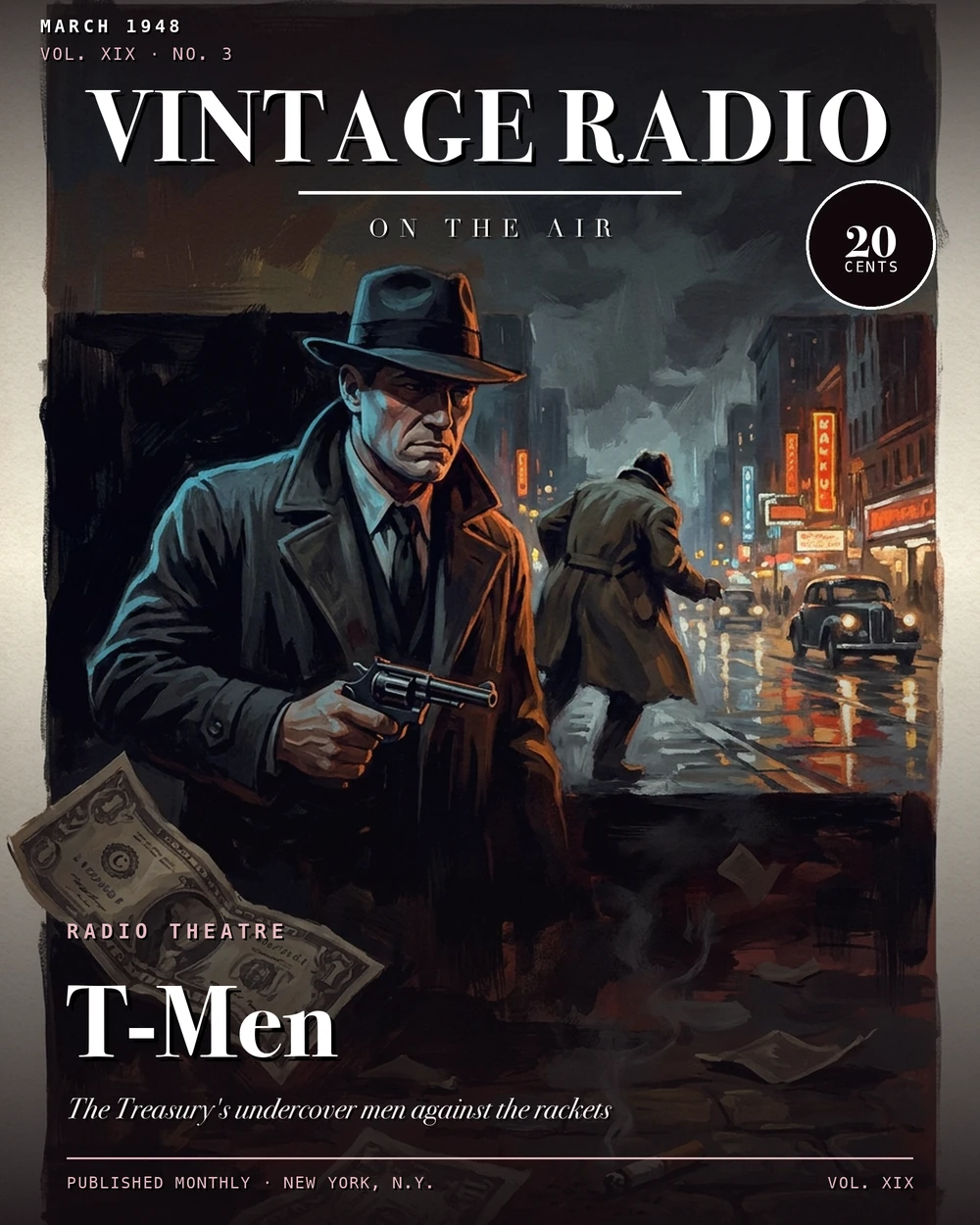
T-Men
The Treasury Agent and the Radio Crime Wave
The "T" in T-Men stands for Treasury — not Justice, as some early catalog descriptions had it. T-Men in American popular culture has always meant agents of the U.S. Treasury Department: the IRS investigators, the Secret Service, the anti-counterfeiting units. That distinction matters for understanding where this show fits in the old-time radio crime landscape. These were federal operators working different cases than the FBI men who dominated crime radio, and the Mob Museum has observed that Treasury T-Men "lacked Hoover's full-throated marketing and were not as popularly mythologized although they had a bigger impact on bringing down the Mob." That gap between impact and fame is exactly the tension these stories ran on.
The show's connection to a 1947 Anthony Mann film noir — also called T-Men, starring Dennis O'Keefe and explicitly endorsed by the U.S. Treasury Department — is hard to overstate. That film earned roughly $3,000,000 on a budget of around $425,000, and its success pulled the concept of Treasury agents into the mainstream. A radio adaptation of the film ran on Lux Radio Theatre on February 23, 1948, again with O'Keefe in the lead role. By the time the radio series found its footing, the audience already knew what a T-Man was.
What the Show Was
The radio T-Man property has a documented CBS run in 1950 with Dennis O'Keefe starring as Treasury Agent Dennis O'Brien, going undercover against counterfeiters and drug rings. A later syndicated version followed in 1956, with Gordon Glenwright playing tax agent Jack Ketch. The dates attached to the episodes in this catalog — and the show's exact relationship to those documented versions — are not fully settled. OTR reference sources place the main radio property in 1950 and 1956, and no source has confirmed a run beginning as early as 1946. The eight surviving episodes here are genuine T-Man radio material; the full broadcast history behind them is simply harder to pin down than it would be for a show with a cleaner paper trail.
What the episodes themselves show is consistent with the confirmed CBS format: each story is framed as a case, with titles like "The Case of the Screaming Widow," "The Case of the Tin Pan Alley Money," and "The Case of the Corpse That Wrote." That "Case of the…" convention matches exactly what OTR catalogs document from the 1950 CBS run, which suggests these eight episodes either belong to that run or are closely related to it.
How It Sounded
The series was built on hardboiled style — sharp dialogue, a brisk pace, and sound design that put the listener inside the action. These weren't procedural lectures about federal law enforcement; they were crime stories with momentum, driven by cases that often drew on real underworld activity for their plots. The voice performances were a particular strength, holding together stories that moved fast and didn't linger on exposition.
Post-war radio crime dramas were a crowded field. This Is Your FBI ran on ABC from 1945 to 1953, and The Silent Men covered similar federal-agent territory. T-Men occupied a narrower lane — Treasury work, with its counterfeiting investigations and tax enforcement cases, didn't carry the Hoover-era mythology of FBI programming. But for listeners who wanted crime drama grounded in the less-celebrated corners of federal law enforcement, the show delivered exactly what the title promised.
What Survives
Eight episodes are documented in the catalog, covering cases that range from financial crime ("The Case of the Tin Pan Alley Money") to something considerably darker-sounding ("The Case of the Screaming Widow"). The full breadth of what originally aired is uncertain, but these eight give a solid picture of how the show worked: a team of Treasury agents, real-case inspiration, and the kind of hardboiled radio craft that defined the post-war crime drama wave.